
Have you created a successful business and are now wondering what your options are to expand your business? You have most likely invested a minimum of hundreds of thousands of dollars to build your business, secure trademarks, develop your brand and online presence, document processes, implement technology, and hire staff. You have a solid foundation. Now what?
Opening additional locations on your own could take hundreds of thousands—if not millions—of dollars that are not easy to access through traditional financing today. As you think of ways to leverage the large investments you have made already, consider that franchising can be a great way to scale your brand to more markets, building upon those investments and years of fine-tuning that made your business a success locally. Franchising links your expertise and investments as the franchisor with the capital and personal oversight of a franchisee to replicate your model in a new geographical market. You are able to leverage the passion, commitment, and capital of franchisees to deliver your goods and services to more customers across a larger geographic region. You may want to expand regionally, nationally, or globally, and franchising is the least capital-intensive (and most proven if done right) way to do so, with less risk and more upside potential than any other method of brand expansion.
Launching a franchise brand still requires an additional financial commitment of several hundred thousand dollars by the franchisor to lay and build the franchise system foundation. But to open more company-owned locations requires significantly more capital than opening locations through franchising. Given that lenders are facing a stricter regulatory environment, record high and long-lasting unemployment rates, and less business collateral, creativity and innovative ideas are required to figure out the best way to expand with limited access to capital. The beauty of franchising is that the geographical expansion into new markets also uses the capital of the franchisees, in essence allowing the brand to expand utilizing other people’s money.
Franchising spreads the risk between the franchisor and the franchisee. The franchisor has invested in the pilot locations and secured their initial success. By experiencing mistakes and fixing them to develop a solid business model that franchisees can replicate, the franchisor has developed and protected the brand and the systems that the franchisee can license and use in its business.
The franchisee is acquiring the right to use the brand and the systems to get started much faster and with much stronger resources than he could on his own, and that right has considerable value. Essentially, to be a franchisee is to be in business forbut not byyourself. The franchisor benefits in offering this opportunity to a franchisee because it helps offset past, current, and future investments in the brand and in the operating systems. When done right, franchising benefits both the company, which wants to expand geographically, and the franchisee, who gets to learn the business and execute the model at the local level.
This book will help you evaluate whether franchising can be a great option for you to cost-effectively expand your business. In addition, once you establish that your business is right for franchising, Grow Smart, Risk Less will guide you step-by-step through leveraging franchising as a proven expansion vehicle. Many of the specifics and examples are based upon my hands-on experience as a franchisor of a service business.
However, the generalities of the steps that need to be taken to franchise and the order of those steps are common to all franchise concepts and will apply in some way, shape, manner, or form for every franchisor. You will need to be properly capitalized, you will need a franchise disclosure document, you will need to build a team, you will need to define a franchise sales process, and you will need to build a mutually productive culture where you and your franchisees can win.
I have focused on the sequential steps that are characteristic of franchising in general and have elaborated on the areas that can have the biggest impact on success, namely, the internal and external teams, the culture, the technology, and the major goals and accountabilities. Beyond those common components, you also must understand the specific characteristics of your business or industry. For example, retail, hospitality, and food concepts will have real estate considerations and different territory definitions, as well as unit economic metrics and processes that are unique to each business. Some of the steps and best practices will apply to you and your business; other steps may not apply or will require modifications. One key to franchising is that “one size does not fit all.” You must decide what will work for you. You also need to know where to go for more information, such as the International Franchise Association, as you drill deeper into your industry-specific issues. A list of resources can be found at the end of this book.
You have spent years getting to this point in your business, and now you have the information to evaluate whether franchising is the right vehicle for you to leverage those years of investment to dramatically grow your business. It took us one full year, from the day we started evaluating franchising as a way to provide our services to more families to the day we sold our first franchise. A recommended timeline to work through the developmental stages is provided in the chart below.
RECOMMENDED TIMELINE TO LAUNCH
From Contemplation to Franchise Launch
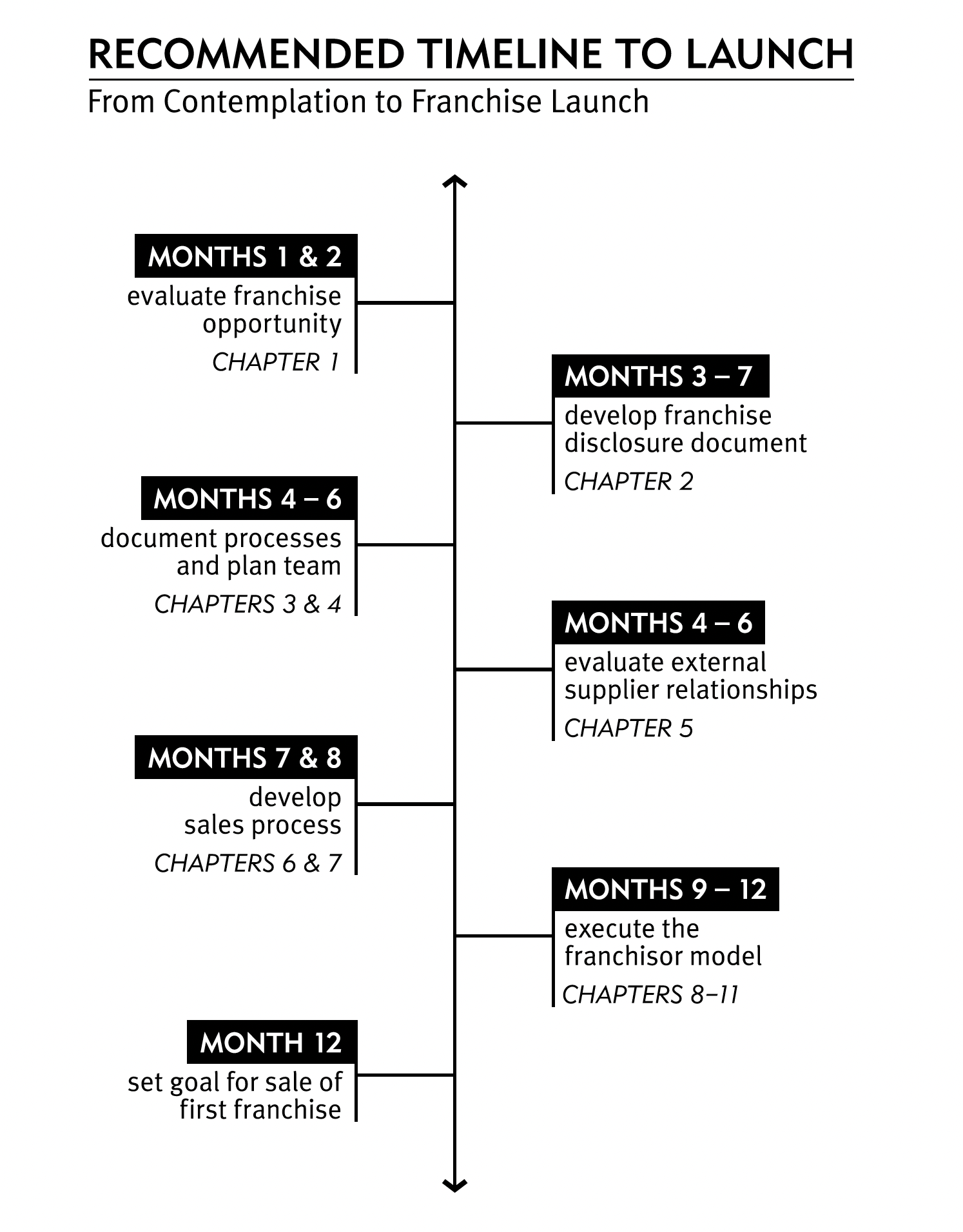
Section 1 (chapters 1 and 2) walks you through evaluating the franchise opportunity, documenting your processes, joining the relevant associations, attending the necessary events, and preparing your franchise offering so franchisees can evaluate the opportunity to join you. Section 2 (chapters 3 through 5) walks you through the importance of defining the company’s vision and culture and the importance of building your internal and external teams from the beginning. It provides a reference guide for the future on how to continue to build out your teams over time. The material in section 3 (chapters 6 and 7) will assist you in selecting the right franchisees and, once you have your franchise offering completed, selling them. Section 4 (chapters 8 through 11) is all about execution and how to be a franchisor. Section 5 (chapters 12 and 13) is about understanding your brand and customers and the relevance they have to building and maintaining a strong foundation for growth and success.
I recommend that you read the book all the way through and then come back to the individual sections at the appropriate time. Use them as a guide to help you determine what to do and what to avoid at each critical stage. The first section lays a needed foundation—with an array of legal, financial, and franchise terms—so hang in there until section 2, because the rest of the book is filled with meatier and more enjoyable topics such as building a team, creating a culture, and building a successful business model for you and your franchisees.
You are entering an exciting time as you evolve your leadership and grow your business from a successful local one to a larger regional, national, or international brand. You had the passion, skills, and determination to get you here. Yes, you will need to learn new things to grow your business through franchising, but you can do it. You will be the ambassador within your organization who will set the tone and the passion for the huge opportunity that franchising can provide when it is done well and with absolute commitment to the interdependent relationship with your franchisees.
When we chose to franchise BrightStar, we could have invested $500,000 in opening three more company-owned locations, or in establishing the franchise platform that has opened over 200 locations in the United States and two locations in Canada in just five years. The franchising model changed our $3 million revenue, two-location business with under $400,000 in annual profit, into a franchise system with more than $100 million in system-wide sales and more than $3 million in annual profit, with built-in growth potential the longer our franchisees are open. Read Grow Smart, Risk Less to build your own possibilities for the future!