You have a great local business. You know you have a product or service that your customers want. Eventually there comes a point when you begin to wonder how to reach more customers. The traditional approach involves raising capital to allow you to open more locations. True, this approach can grow your brand and allow you to reach more customers, but it also means that expanding your business is all up to you. You will be securing and signing for the debt or outside equity and ultimately signing on the dotted line and taking on the increased risk of expansion.
Another avenue for achieving growth in revenues and customers, with more limited capital and potentially less risk, is through franchising, though many business owners do not consider it. Franchising is a great vehicle to help you reach more customers, promote your brand, and increase your visibility and credibility as a brand. Franchising provides a method for expansion through which you are able to grow smartly by increasing revenues at a steady rate with franchisees that are hand-selected to be ambassadors for your brand.
Both the franchisor and the franchisee benefit from this approach. Franchisees invest capital to grow their business at the local level, but they don’t have to spend significant amounts of time and resources to figure out every single aspect of the business. As a franchisor, you are licensing your knowledge, trademarks, and systems to them. In doing so, you will leverage the investments you have already made in your brand and in your systems. In return, you earn a stable revenue stream, normally based upon the revenue results of your franchisees.
Franchising is also a powerful mechanism for accelerating growth. Franchisees provide new sources of passion, ideas, and capital. As you read on, you will learn how to create a culture in which franchisees are working hard to build their local businesses, spreading the word for your brand, and bringing great ideas back to you to make the business model stronger for everyone. Franchising is truly about shared success—growing smart—with less risk than going it alone. Good alone . . . better together.
Several critical components need to be in place before you launch a franchise: a thorough understanding of your industry; sufficient experience in your business; a thorough understanding of prospective franchisees’ interest in your model/industry; and the building of a solid, profitable and proven business model. Additional steps to be completed after you decide to franchise and before you actually begin to offer franchises for sale include securing trademarks and setting up a strong legal structure.
Understand Your Industry
The first component to look at in evaluating whether you are ready to franchise your business is your knowledge of your industry. As a business owner, you likely understand the competitive landscape in your local market. In preparing for franchising, it is critically important to understand the industry at a broader and more intimate level. Is the demand for your product(s) or service(s) growing or shrinking? Who are the buyers for your product(s) and service(s) and how are they finding you? The assessment of the demographic trends of customers and the pool of employees needed to meet customer demand will be necessary as you evaluate the opportunity to expand through franchising (and the best geographical areas in which to begin).
A franchisee’s decision to invest a large portion of personal wealth is a difficult one and, in many instances, life changing. Franchisees need to feel confident that the franchisor knows what to do. I am amazed, and quite frankly perplexed, by the number of franchisors who begin concepts without having first invested their time and money in company-owned units and who have not expanded to additional locations or territories to ensure that their model could be replicated.
AVOID THIS PITFALL:
Don’t try to franchise a business without proving success through your first unit(s).
When I was deciding to become a franchisee in two hotels, my criterion was that the franchisor I invested with would have at least 500 locations, with a majority of them doing well, or would have successful company-owned locations.
Throughout the book, I will stress the importance of company-owned units in building a strong foundation for franchising. All of the benefits of company-owned units that we will touch on—helping to understand the business, helping to understand the impact of changes in the model, building credibility with franchisees when they question actions, etc.—add up so that the sum of the parts (having those units for the specific reason being illustrated) are muchgreater than the whole (having company-owned units simply to generate revenue).
Not all concepts require you, the franchisor, to continue to run the company-owned unit(s) after you begin franchising. Selling the company-owned unit(s) can actually be a way to attract the first franchisee and bring in a large infusion of cash that can be reinvested in launching the franchise system. I think the complexity of the model and the level of change in the industry should influence your decision to keep the units or sell them.
We had two locations when we decided to franchise (and added a third later before selling our second and third locations to franchisees), having taken the time to ensure that our first location could be replicated to a second location and having worked through the challenges and/or customizations needed to expand to additional locations. We decided to keep one company-owned unit because of the rapid changes in healthcare expected over the next 10 years. Rather than have our franchisees try unproven, potentially expensive programs, we believed our unit should serve as the incubator to test new technology, new sales techniques, new marketing programs, and so on. Franchisees are running their businesses and have limited bandwidth for identifying changes to the business model and/or testing new marketing programs. By fully vetting and adapting new ideas in our company-owned unit to determine how to help franchisees implement them with the least disruption to their businesses, we could demonstrate that we were invested in it with them for the long haul and were committed to planning and executing the right strategies to be successful.
The Competition
You have to know how your offering will compare with that of the competition in your industry. Benchmarking your competition is a critical exercise that you will need to repeat annually. At this beginning stage, I recommend that you invest in research. I have developed a strong reliance on FRANdata (see the recommended resources list in Appendix B) to supply the franchise disclosure documents (FDDs) of my competitors each year. I look at how competitors’ offerings have changed, how their franchisees are performing, how many units they have added, and how many locations closed. I also look at their audited financial statements to see how the franchisors are performing on such key metrics as revenue per dollar of payroll and earnings before interest, taxes, depreciation, and amortization (EBITDA) as a percentage of revenue.
The extent of the competition will set the bar for how your system needs to perform. In any highly competitive industry, you will need to have compelling evidence that your model is better than the other choices available. We knew we were among the best when we looked at our revenues for our early years compared to our competitors’ numbers for theirs (when reviewing their FDD Item 19, which we will discuss further in chapter 1). The performance of our company-owned units was important in attracting the first franchisees to our system. We also understood that we had a unique model because the majority of our competitors serviced only seniors and did not provide skilled medical care; we could tell this from the evaluation of their FDD Item 1 (see Appendix A for a description of each item in the FDD).
The information provided from competitor FDDs allows us to compare our offering from a franchisee’s perspective and to glean a sense of the profitability of other franchisors based on their current performance. What is missing is information about competitors’ performance in their early days as a franchisor. When we launched our franchise system, we needed to build budgets around what we believed we could do; we needed to demonstrate to our bankers that our assumptions were realistic. Comparing what you expect to do in your first five years as a new franchisor to the eighth, tenth, etc., years of a franchisor competitor’s performance is comparing apples to oranges. A valid comparison requires a larger research study and is really where FRANdata excels. So let’s look at the study we commissioned and how we used it.
From a market study FRANdata prepared for us, we knew our competitors’ ranges of unit growth per year in their first 10 years of operation and the key franchisor profitability statistics. This information allowed us to plot our key goals for years one through five on charts for unit sales, cumulative units, total revenues, royalty revenues, EBITDA, revenue per dollar of payroll, and an estimated level of unit sales per franchisee, along with data points for each competitor to show that our goals were within the range of what was possible in our industry. A lender is more willing to make a loan when you can demonstrate what others in your industry have accomplished.
Review the average unit sales at the franchisee level among competitors. Some franchisors will disclose how their franchisees perform in Item 19 of their FDD. This is a valuable way to keep tabs on your competition and valuable information for prospects evaluating the opportunity. If the franchisee performance information isn’t disclosed in the FDD, then all you can do is try to estimate it for the aggregate of all franchisees regardless of how long the franchisees have been open. All you need to calculate the average unit sales are the following pieces of information: Item 20, beginning and ending units for a one-year period (to calculate the average number of units); the royalty percentage from Item 6; and the audited financial statements (particularly the royalty revenue line for that year). Divide the royalty revenue line by the royalty percentage to get system-wide sales, which can be further divided by average units to get the estimated average unit sales per franchisee. You can use the research study to understand what the competitor’s metrics are in the current period compared to what they were year by year in their early stages.
To estimate the average franchisee sales for competitors if this information is not disclosed in Item 19 of the FDD:
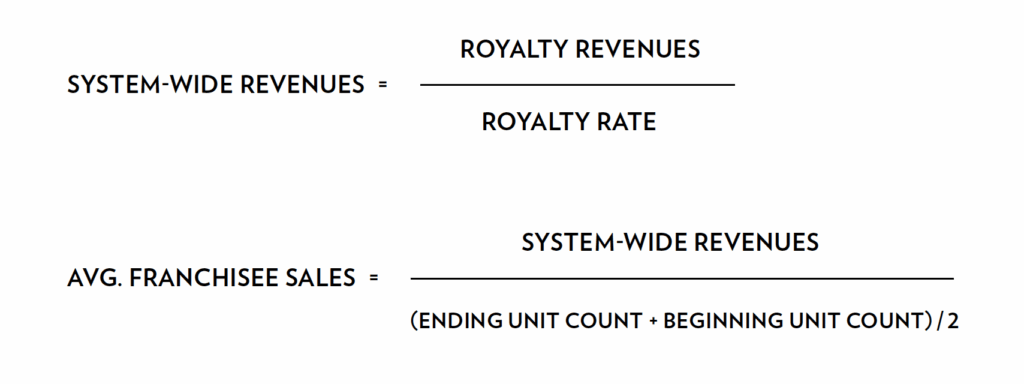
This is an important number to understand initially as you consider whether to franchise your business, and it will help you become more competitive over time. It is very important to your ability to sell franchises to have a model that is producing among the highest returns in the unit’s first, second, and third years compared to your competitors, and then to appropriately disclose the company-owned unit performance in Item 19. If your average revenues per franchisee are less than your competitors’ in the aggregate with the above calculation, don’t worry. Your competitors have the benefit of having franchisees that have been in business for years: They should have higher sales than franchisees that have been in business for a shorter period of time. But also recognize what you need to do to improve those results as your system matures.
Evaluating the competition is a critical component in understanding your industry, but it is not a one-time event. Benchmarking your competition is an important exercise that you should undertake regularly to evaluate your trends (improving or declining) compared to your competitors’. I still thoroughly compare key metrics with my competitors each year as part of the budgeting process. We review the most recent FDD and the audited financial statements of the 10 largest competitors in our industry. If there are publicly traded non-franchise companies in your industry, you should also access and evaluate their information, metrics, and competitive differentiation.
We had solid revenues and were a top performer in terms of royalty dollars per unit when comparing our early years to the competitors’ early years. However, in the first four years we lagged behind our competition in the efficiency metric, revenue per dollar of payroll, and in EBITDA as a percentage of revenue. We lagged because we had intentionally made an early decision to invest heavily in staff—well-qualified people and more of them (as further explained in chapter 4). I was willing to invest in the quantity and quality of support, including 15+ years of experience on average for franchisee field support and BrightStart team members (BrightStart is the fast launch team we added in 2009 and is discussed in detail in chapter 9). Of course, this decision was expensive, and I knew that in our early years it would put us behind our competitors in efficiency and in EBITDA, but I believed that it would pay for itself in the long term. By the fourth year we started to outperform the majority of our competitors, and our fifth-year numbers were in the top quartile of our peer group based on our competitive benchmarking analysis. Over time, this early investment in talent more than justified the expense.
By now in the evaluation stage you should be able to determine if your franchisees would have a good opportunity to make money if they followed your model. You should know how your model stacks up on ROI compared to your competitors’. The advantage of taking the time to thoroughly evaluate the competition is that you gather the information on what the competition charges its franchisees in terms of fees—royalties, national ad fund (NAF), technology, and any other fees—that you will need to subtract from your company-owned model results to create a pro forma of what the results for a franchisee would be after these costs are paid to the franchisor, to further validate that this results in a strong return for the franchisee for the level of investment she will make. This analysis also allows you to see the range of the fees charged among your competitors to assist you in determining what you will charge. You will evaluate what the competitors charge as well as evaluate what creates a win-win financial model for the franchisees and franchisor in the amounts charged.
During our evaluation we were able to see that the majority of our industry charged a 5 percent royalty, so we chose this as well after evaluating that this fee level should allow the franchisees and BrightStar to make acceptable levels of return for our investments. We added a 6 percent royalty on national account business because we saw an opportunity to build a team that would develop contracts on our franchisees’ behalf and charge a slightly higher royalty to offset our costs to develop and maintain this opportunity for our franchisees. Likewise, we were able to see a variety of NAF fees charged, and while many were lower than what we chose, we believed that we could add more value to our franchisees in leveraging the purchasing power of the whole system by handling more advertising, media, and public relations and the corresponding promotion that an NAF provides. Based on that belief, we chose a rate among the highest in our industry. Lastly, we were able to see that nearly every competitor required its franchisees to purchase technology through a third party and that the franchisors did not have the competitive advantage of technology and the innovation that comes from owning their own technology. We were able to review the technology fees charged for out-of-the-box technology solutions and used this information to set the technology fee that we would charge to partially cover our costs and allow us to continue to innovate.
Strong Customer Demand for Products and Services Another component of understanding your industry is to keep abreast of current (and future) customer demand for your products and services beyond your current geography. Certainly one of the main benefits of franchising is getting your products and services to more markets and thus to more customers. Therefore, it is critical that there is a strong customer demand for the products and services you offer from a macro perspective—people must eat, people will need healthcare, people have pets, etc. You should understand the underlying trends for your industry to ensure that it is growing and that it is also projected to grow over the next 10 to 20 years.
Nearly every industry has strong competition. I believe that healthy competition keeps me (and our company) on our A-game, is good for the industry, and shows me there is demand for what we sell. It is critical that you understand your brand positioning at a local level so you know how to elicit customer demand across a larger geographical reach. Are you the lowest-cost, highest-service, or best-quality provider in the market? You will need a unique differentiation to best exploit the market opportunity through franchising. Assess what has differentiated you locally and compare that to the national competitors in your sector to accurately establish that you have a compelling differentiation nationally. This may require exploration on how to add features and benefits to your offering so that your market differentiation is secured and recognized at a broader level.
Understand Prospective Franchisees
In addition to understanding whether customers want and are willing to pay for your services, you must evaluate the interest of prospective franchisees in buying your concept rather than another’s. Obviously the business model must deliver adequate returns (and we will look at this in the next section), but the prospective franchisee must want it. It has to be a better/unique/more sustainable franchise solution than what is currently being offered. In many instances, this point can be defined as ROI and the quality-of-life returns for the target franchisee.
The prospective franchisee must see the value of what you have to offer, for which he will pay a fee up front (defined as initial franchise fees) and a recurring fee over time—usually as a percentage of his revenues (defined as royalties or license fees). Do you have a recognizable brand? Do you have proprietary technology? Do you have sales and operations systems that deliver a higher ROI than others? Do you have a leadership and/or vision advantage? Do you have strategic vendor or customer contract relationships? You need to demonstrate an ability to deliver superior processes, support, and leadership to allow franchisees to get to breakeven significantly faster than they would do on their own (to justify the initial franchise fees and the royalties) and faster than other franchisors for them to select your franchise rather than doing it on their own or with another franchisor.
In addition to the financial return and customer demand that must be in place, you need to see if franchisees want to be in the business of selling what customers want. You need to know if other franchisors in your sector are growing, because it will show you whether or not franchisees are interested in that particular industry segment. For example, look at the doggie waste pick-up business. There is clearly a market from a customer demand perspective, as demonstrated by the Humane Society statistics citing that 77.5 million people in the United States own dogs and that 39 percent of U.S. households own at least one dog. Yet despite good unit economics, this franchise sector is generally not growing at a rate that reflects customer demand. Could it be that people just don’t envision themselves in a business where they are cleaning up dog waste for a living? Customer demand and franchisee interest are both necessary components to assessing the future potential of your concept.
Build a Solid Business Model
Your experience in your own business and in becoming an expert in executing your own business model provides a strong foundation with which to begin a successful franchise journey. It is not enough, though, for you to make money running a company-owned model. You must take that knowledge and adjust your results for the additional costs a franchisee will have in licensing your brand, your technology, your systems, and your processes. You must prove that the business can be successful with average performers and not only exceptional performers like you.
The business model must be assessed from both the franchisor and the franchisee vantage point to ensure that both parties can make reasonable ROIs. If you have company-owned units, this is a much easier exercise. You can take the results from your first through fifth years (or fewer, if you have had your locations less than five years) and model the results for a franchisee in the same business with the adjustments that a franchisee would incur, such as NAF charges, system fees, royalties, and hiring and training employees.
Next, you will want to build a spreadsheet to review what the franchisee results would be at various levels of performance in revenues, or contact us at www.growsmartriskless.com and input the code word GROWSMART to access a template to help you with this evaluation. It is helpful to evaluate the results for a range of revenue scenarios—based upon a 25 percent under-performance through a 25 percent over-performance (or 75–125 percent of targeted revenues)—to see what the franchisee’s results would be at certain revenue levels that are 75–125 percent of those achieved by the company-owned model. When looking at our system and at new concepts, and when mentoring, I assume that a franchisee puts up 30–40 percent of the capital for the launch of a franchise. I also assume that the franchisee could earn an acceptable level of return by the third year (generally 15 percent or more of capital investment) if handling one of the full-time roles (i.e., not hiring someone else to do it) and after covering debt service. As noted earlier, you may need to make adjustments to this evaluation based on your business and your industry.
This analysis is assessing reasonable returns for the franchisees while they are running their business, and the value of their business when they decide to sell it is incremental to reward their “sweat equity.” In the current economic environment, I believe the most successful models are able to produce a reasonable return for the capital invested, deliver a reasonable salary by the third year if the owner is working full-time in the business, and create an opportunity for wealth for a franchisee’s retirement when the business is sold at a later date. Of course, this analysis is based on the assumption that the franchisee follows the business model to achieve at least 75 percent of past results. I like to see a franchisee in a position to take a reasonable salary and/or a distribution at some point beginning in year two.
All franchisees have different expectations for the time period in which they should begin making money and the amount of money they want or need to make to achieve an adequate return. Some are looking to replace their salary (and that could be a wide range from $30,000 to hundreds of thousands of dollars per year). Industries, as well, have different expectations of return, based on the level of the investment. The level of expected return will also vary if the franchisee will be an investor (and is therefore able to keep her existing job) or an owner-operator (and must commit full-time to the business she is buying), and if there is real estate involved (and if the franchisee buys it or leases it back to or from the franchisor). Also, prospective franchisees in different industries will have different pressure points in evaluating the opportunity: For example, restaurant investors may be focused on the sales-to-investment ratio and the combined costs of goods (food and labor costs). Different industries will have different metrics; you need to know yours and demonstrate that you are a top performer as a new entrant to attract franchisees.
Generally, investor franchisees (rather than owner-operators) are willing to wait longer for investment recovery. Today, owner-operators are becoming less patient than in the past and expect a quicker return, though I think the new economy is creating more realistic expectations as to the level of returns, just as the employment market has lowered expectations for salaries and benefits. From my networking in the franchising industry, I deduce that there is a common viewpoint that many owner-operators, particularly those in service industries, are looking for replacement income quicker, and this is important to understand in evaluating how strong your business model is. These owner-operators are looking for concepts that have an opportunity to deliver breakeven levels by the end of the first year or so, replacement income in year two, and recovered cash by the end of year three. Again, these are generalities and will vary when the franchisee is buying capital assets, buildings, equipment, etc.
There are a few good consulting groups (ask around and see who is active in the International Franchise Association before choosing) to assist in launching a franchise system. However, it is critical that a feasibility analysis be completed first, prior to spending money to launch a franchise system. When I hear a new franchisor talk about paying a consultant more than $100,000 to launch a system and there was not a thorough feasibility analysis early on (at a fraction of the price), I see a red flag. That franchisor doesn’t know with any certainty whether his franchisees will make money according to his business model; he doesn’t know how the ROI on his offering compares to that of his competition; and he doesn’t know if he is adequately capitalized until the franchise entity reaches royalty self-sufficiency. More often than not, new franchisors don’t even know what “royalty self-sufficiency” means (we will discuss that in chapter 8). Even though these are some of the most important questions new franchisors need to have answered, the consulting group typically gives them only an FDD or related franchise documentation, an operations manual, and marketing materials. The consultant may never work with the new franchisor on a detailed analysis of these critical financial factors. Rather, the consultant’s work product will be founded on the assumption that the new franchisor has the answers and that they are favorable. Why spend such a large sum of money without first ensuring that the concept is franchise worthy? This is your responsibility, so own it.
Establishing the Legal Foundation
Once you are confident in your ability to franchise, you need to lay a strong legal foundation by protecting your trademarks beyond your local market and by establishing the legal structure from which to launch the franchise.
Securing Trademarks
As you think about expanding, it is critical that you protect your brand. The first step is to hire an intellectual property attorney to perform a search with the U.S. Patent and Trademark Office (PTO) to ensure that your name or mark is not being used elsewhere and that you can obtain the rights to use it nationally. It would be a disaster to begin to expand into other markets and then find out that you do not have the legal right to use your name or mark in that market. You could be sued for using the name of an already established business.
As a small business owner, you may think that you already have a lot of brand equity, but that equity won’t go far if you are unable to protect it and other businesses own names, URLs, and intellectual property that is similar to your own (and quite possibly trademark protected).
If you are unable to get the trademark rights for your business’s name, you will need to invest in creating another brand before franchising. When we started our company-owned location in 2002, our name was very generic (24-7 HealthCare Solutions). We made a $40,000 investment in 2004 to create a brand for which we could secure trademark rights and which customers would remember. We already had loyalty to our services and company, but we knew we needed to invest in building and protecting a brand. In addition to the $40,000 we spent to create the initial BrightStar brand, we spent $30,000 to have another company withdraw their PTO application for“BrightStar Recruiters” and about $10,000 in PTO filing fees.
AVOID THIS PITFALL:
Avoid generic branding, like what we had in the beginning, in favor of spending the money for a professional branding firm to help you create a brand identity that embodies your core market differentiators and/or your brand’s customer promise.
You should own the website addresses, or URLs, for your brand, and someone in the company should have an eye on ensuring that the ownership rights do not lapse. Your attorney should offer monitoring services to ensure that trademarks and URLs are renewed on a regular basis (although it’s probably good backup to assign this task to an in-house staff person too). You also want to think about securing additional URLs that encompass your brand, such as “namefranchise.com” and “namefranchising.com,” so you have them for the future franchise sales website.
BRIGHT IDEA:
I recommend investing in URLs that others may try to buy if you don’t, such as “name-sucks.com,” “name.net,” “name.org,” etc.
The costs are minimal and help to protect your brand from derogatory sites or brand confusion in the market.
Finally, if you have developed your own technology that your franchisees will use, I recommend consulting with a patent attorney to see if what you have built can be protected. The technology will need to be unique, but this can be a smart investment to protect against franchise prospects who may be your competitors in disguise.
Legal Structure
Franchising has many legal considerations. In this section we will focus on establishing the appropriate legal entity for the franchisor, and then in chapter 2 we will review the preparing and filing of the FDD. The areas that are common in setting up all business entities—such as acquiring a federal employer identification number (FEIN), determining the entity type, and then preparing the bylaws, articles of incorporation, and/or the operating agreement—are excluded from this section, as these are not unique to franchising and were steps you had to undertake in the formation of your company-owned legal entity.
I am often amazed by the risks that franchisors take by leaving their company-owned business in the same legal entity that they use for their franchise system. I would not want to risk all the future potential of my franchise system to an unhappy customer or employee of my company-owned unit. We separated our company-owned entity from our franchise system from the beginning.
That being said, however, we did make a change in early 2010 to further separate our company-owned entity into two entities. After reviewing our original trademarks, we realized that the entity not only owned the trademarks but also owned and operated the company-owned locations. At that point, we made the investment to move the intellectual property into a separate entity for its protection and then formed a new entity for the company-owned operations.
BRIGHT IDEA:
Regardless of the size of your franchise system, the review of where your intellectual property is held and the separation of it from company-owned operations and from franchise operations is a worthy exercise to undertake with your board of advisors and attorney.
Closing Thoughts
You have spent years, passionate energy, and financial resources building a successful business. You are ready to expand and have begun to evaluate whether franchising can be a way to leverage your investments up to this point.
In this chapter, you learned how important understanding your industry and your business experience to date will be in launching a successful franchise system. Franchising builds upon your solid business model and customer demand for your goods and services. That said, the important point here is that franchising is a new business. We went from being only in the healthcare business to also being in the franchise business.
Franchising provides a low-risk and proven model for expansion for both the franchisor and the franchisee when the model is financially strong and executed properly with the right foundation. You have the tools to evaluate the investment a franchisee will make and to compare that with what your competition offers. Once you have determined that you have a model that can deliver financial success for the franchisor and the franchisee, you will want to invest in securing your intellectual property and building a solid legal structure.
Growth through franchising will require you to learn new skills and to adapt a new approach, which we will discuss throughout the book. Leading franchisees is different from leading employees: The former requires the ability to manage a business, which runs more on influence, than does the latter, which is more a matter of command and control.
· · ·
As a final step in your evaluation, you can also access a 360-degree assessment tool at www.growsmartriskless.com to help you interview key employees, customers, suppliers, other stakeholders, and—most important—target investors about the potential to replicate the model for others.
Now that you’ve completed your assessment and determined that you have a business concept worthy of franchising, it’s time to get further educated about franchising, to secure capital, and to prepare your FDD. Continue on to chapter 2 for tips on each of these areas.


Community Q&A