Now that you have a plan for your personal future, it is time to turn your attention back to the business. You know what responsibilities you are handing off, but who is taking them over, and how do you actually pass the baton?
Whether you’re promoting from within or bringing in an external hire, the next two steps in the Transition Playbook will walk you through the logistical frameworks of finding your successor and supporting their growth into the CEO role.
Every founder and every company is different, which is why there isn’t a one-size-fits-all answer to this challenge.
Instead, evaluate your current team and business needs using the Three-Path Decision Framework:
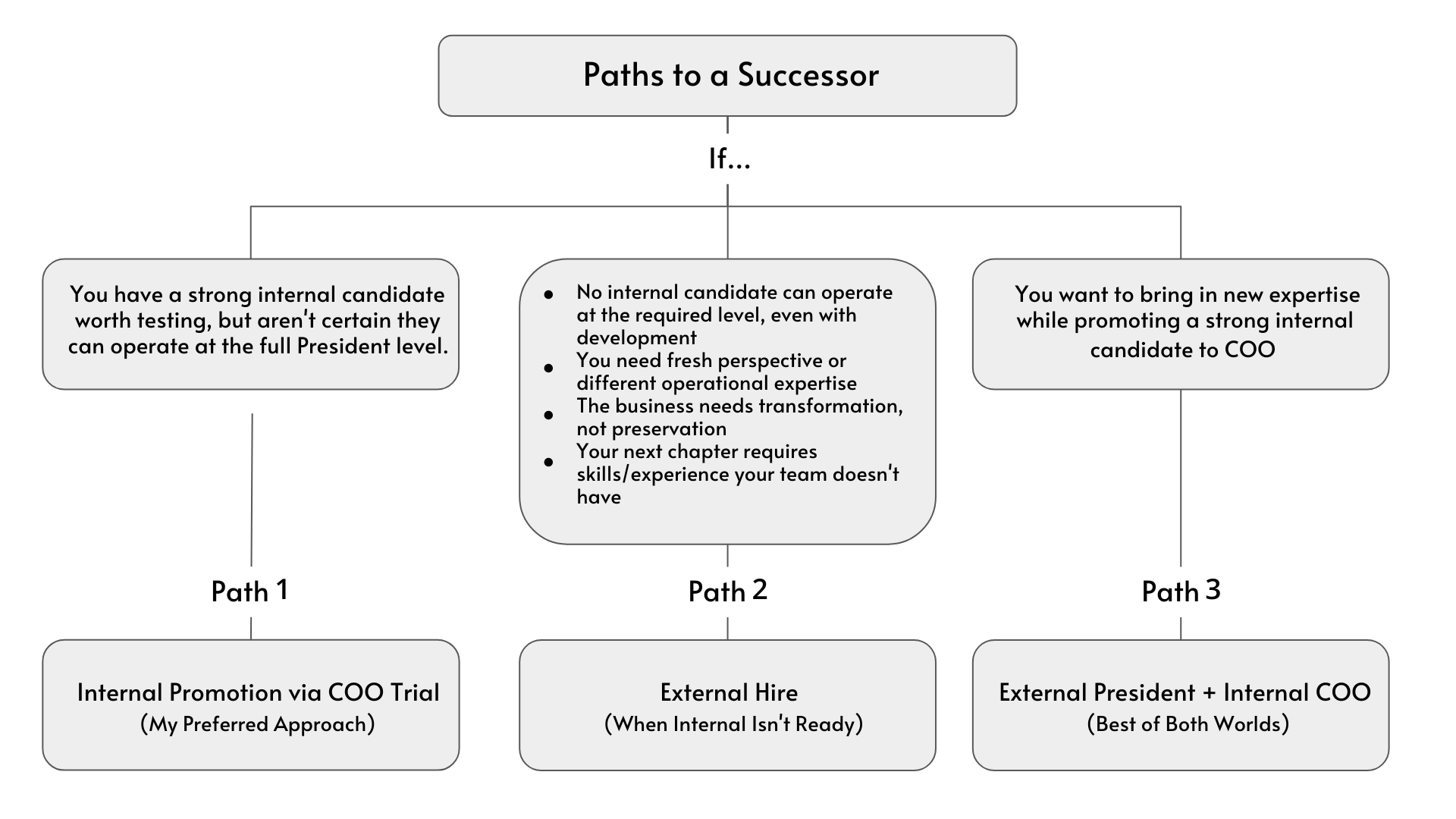
As you can see in the framework above, you generally have three options when finding a successor:
- Path 1: Internal Promotion via COO Trial (Preferred Approach): Use this when you have a strong internal candidate worth testing, but aren’t certain they can operate at the full President level. They enter a 6-12 month proving ground with clear, measurable business objectives.
- Path 2: External Hire: This is the best route when your internal candidates aren’t ready, the business needs a major transformation, or your next chapter requires operational expertise your current team doesn’t have.
- Path 3: External President + Internal COO: The “best of both worlds” approach. You bring in fresh strategic perspective from the outside, while promoting a strong internal candidate to preserve institutional knowledge and create a clear succession pipeline.
The Reality of the Timeline (And Why You Must Be Ready to Pivot)
Alongside the Transition Playbook, you can download the Transition Timeline and the Action Plan. From my own experience and my advisory work with other founders, I know that stepping out of the operator seat isn’t a quick process—it is often a 2-year journey. The Action Plan maps out an estimated timeline for the process depending on your chosen path.
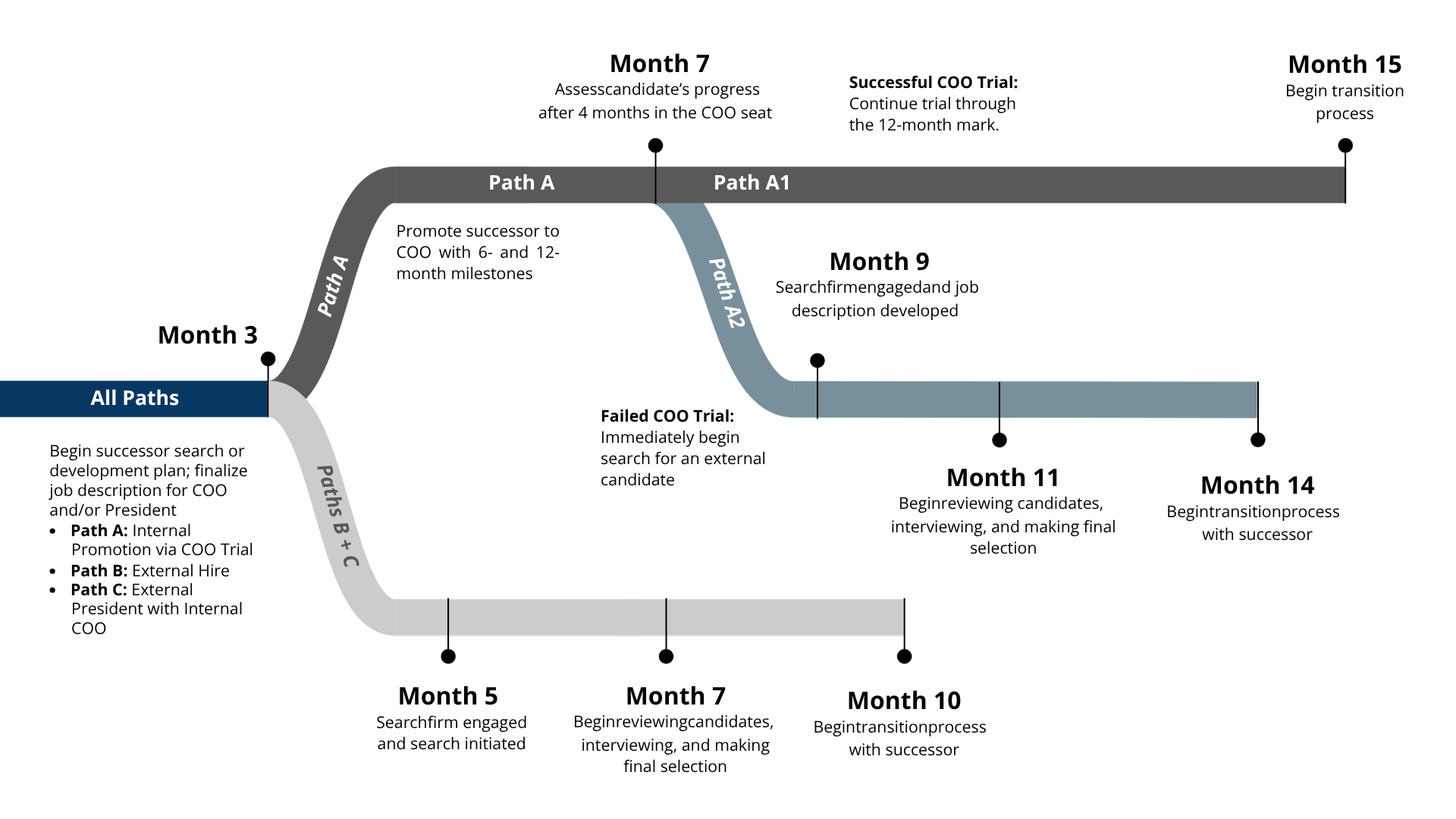
Starting at Month 3 of this process, your timeline will fracture depending on the path you choose:
- If you choose the Internal COO Trial (Path 1): This timeline requires rigid objectivity. You will set 6-month and 12-month milestone targets. However, if they are off-track at the 4-month mark, you must immediately pivot. You begin interviewing search firms and preparing the job description concurrently so that by Month 6, you can cleanly transition them to a COO role and launch the external search without losing momentum. If this pivot happens, you will likely hit the 1-year mark before your new President is fully in the seat.
- If you choose an External Hire (Paths 2 & 3): The search process takes time. Once you decide to go external, it takes about 2 months just to engage a search firm, develop the job description, and start seeing candidates. Add in a couple of months for interviews and case studies, plus notice periods, and your new hire might not actually be in the seat until Month 10.
Before you dive into the Playbook, keep these critical insights in mind:
- Hire for the next chapter, not the last one: Your instinct will be to find someone who does exactly what you did. Don’t. You are not hiring to replace yourself; you are hiring to architect the future. Hire someone who does what the business needs next.
- Avoid the “courtesy promotion”: If you choose Path 1 (the COO trial), it must be a real proving ground. Be explicit upfront: document specific, measurable milestones that trigger the ultimate promotion. A trial without objective metrics is just a delayed failure.
- The CEO title must be earned, not granted: Regardless of which path you choose, reserve the CEO title for two years post-hire or promotion. Bring them in as President or COO. The CEO title signals ultimate authority, and reserving it creates a clear performance milestone tied to demonstrated results.
- Respect the pacing: Do not rush the timeline. Premature exits create chaos because the successor hasn’t built enough authority, while prolonged, muddy half-transitions create confusion for your team.
In our final post, Part 6: What You’re Actually Building, we will cover how to establish new rhythms, set clear approval boundaries, and resist the pull back into day-to-day operations.


Community Q&A